
The digital canvas has undergone a seismic shift, and if you haven’t been paying attention, you’re about to be stunned. Remember the days (just a couple of years ago!) when AI art was largely abstract, often a little uncanny, and more of a tech curiosity? Fast forward to late 2024 and early 2025, and we’re witnessing the dawn of hyper-realistic AI artistry that frequently blurs the line between machine-generated and human-created masterpieces. The leap in quality is frankly insane.
This isn’t just about creating pretty pictures anymore; it’s about generating complex scenes, photorealistic portraits, intricate designs, and entire visual narratives with a text prompt. Suddenly, every designer, marketer, content creator, and even hobbyist needs to consider integrating AI into their workflow. But with great power comes a critical question: which AI art generator is actually worth your investment?
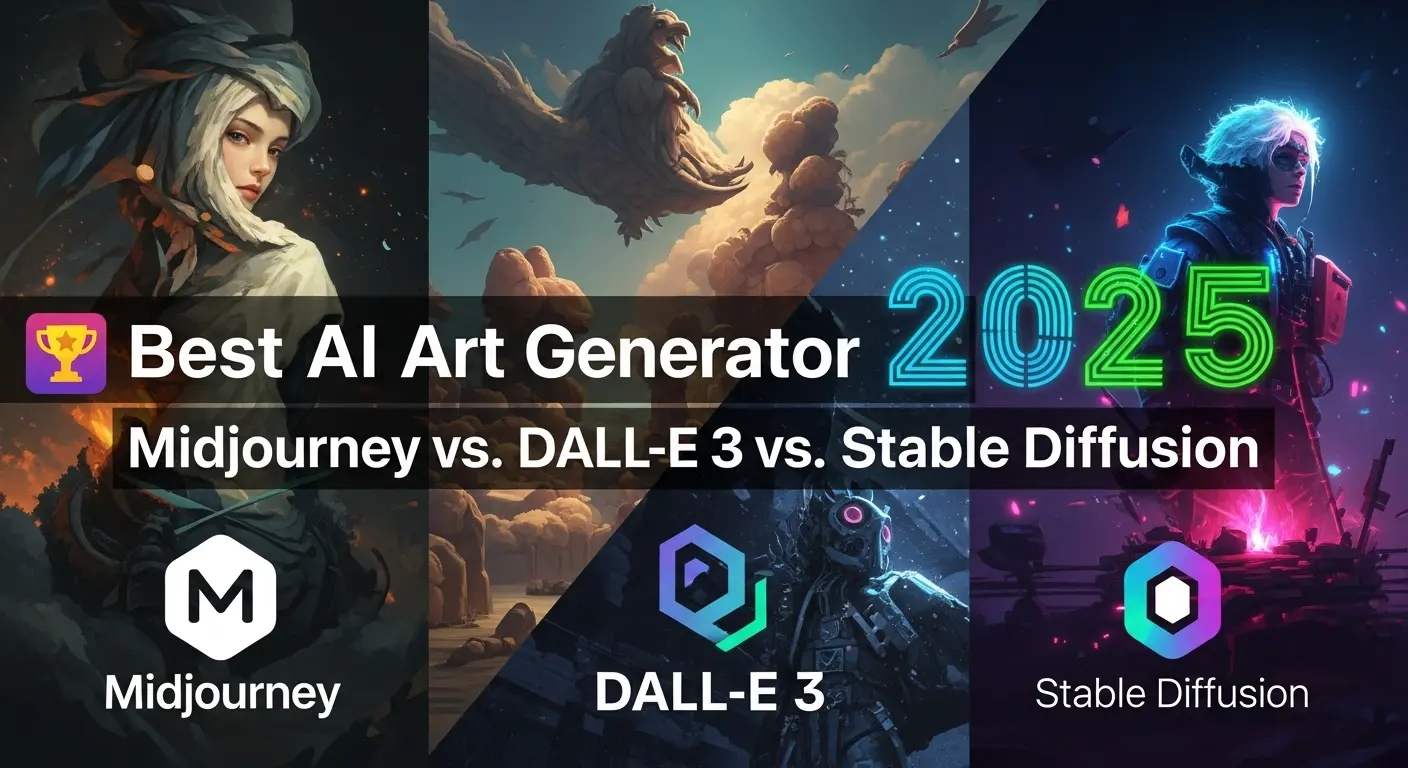
In this rapidly evolving landscape, three giants stand head and shoulders above the rest: Midjourney, with its unparalleled aesthetic quality; DALL-E 3, seamlessly integrated and intuitively powerful; and Stable Diffusion, the open-source chameleon offering ultimate control. Each boasts unique strengths, distinct pricing models, and caters to different user needs. My goal in this deep dive is to cut through the marketing hype and help you identify the best AI art generator that not only justifies its cost but also propels your creative vision forward, ensuring your wallet is ready for the right kind of innovation.
The AI Art Revolution: From Novelty to Necessity
Just a few years ago, AI art was largely a fascinating curiosity – generating intriguing, often abstract, but rarely production-ready images. Fast forward to late 2024, and we’re witnessing a complete paradigm shift. What began as a captivating novelty has rapidly evolved into an indispensable tool for creatives, marketers, and developers alike. The speed of this evolution is staggering; algorithms now produce visuals so photorealistic, stylistically perfect, or conceptually accurate that distinguishing them from human-made art is an increasingly nuanced challenge. This isn’t just about making pictures; it’s about a fundamental change in how we ideate, prototype, and produce visual content at scale.
This rapid innovation has propelled three titans to the forefront of the generative AI landscape: Midjourney, with its unparalleled aesthetic prowess and cinematic output; DALL-E 3, seamlessly integrated and intuitively powerful through natural language understanding; and Stable Diffusion, the open-source champion offering ultimate control and customization. Each boasts unique strengths, user experiences, and, crucially, distinct cost structures.
In this article, our mission isn’t just to marvel at their capabilities, but to cut through the hype and help you identify the best AI art generator that truly justifies its investment for your specific needs. Whether you’re a casual hobbyist, a professional artist seeking a workflow accelerator, or a developer pushing the boundaries of AI, understanding which platform aligns with your skill level, desired output, and budget is paramount. We’ll dive deep to ensure your money is well spent on the right creative partner.
Midjourney: The Artistic Visionary – Is Beauty Worth the Price Tag?
When we talk about sheer aesthetic brilliance in AI art, Midjourney consistently leads the conversation. Its output is frequently described as cinematic, painterly, or even dreamlike, possessing a distinct artistic signature that many other generators struggle to emulate. With recent iterations like v6 (and looking ahead to potential v7 advancements in 2025), Midjourney has refined its ability to produce hyper-realistic textures, complex lighting, and emotive compositions, making it a go-to for high-fidelity visuals. In my experience, if you’re chasing that ‘wow’ factor straight out of the gate—imagery that feels professionally art-directed—Midjourney delivers.
The interface, uniquely housed within Discord, can initially present a learning curve for some. However, this unique setup fosters an incredibly vibrant and active community, which is invaluable for learning, sharing prompts, and discovering advanced techniques. Midjourney’s true power lies in its sophisticated prompt modifiers like –ar for aspect ratio, –sref for style referencing, –raw mode for less opinionated results, and –v for version control. Mastering these commands allows for an astonishing level of creative control within its distinct artistic paradigm.
So, is that beauty worth the price? Midjourney operates on a subscription model with various tiers (Basic, Standard, Pro). For professional artists, conceptual designers, and anyone requiring top-tier visual assets for marketing, game development, or film pre-production, the investment often pays off. It’s an ideal tool for rapid ideation of high-quality mood boards, intricate character designs, or stunning advertising creatives that demand visual impact. If your primary goal is to generate truly artistic and visually compelling imagery, Midjourney makes a strong case for being the best AI art generator in its class, despite the cost.
DALL-E 3: The Integrated Innovator – Seamless Creation at Your Fingertips?
DALL-E 3 isn’t just an image generator; it’s a seamless extension of OpenAI’s powerful language models, most notably accessible through (ChatGPT Plus) and (Copilot Pro). What truly sets DALL-E 3 apart, in my experience, is its deep integration with natural language processing. You don’t just prompt it; you converse with it. ChatGPT or Copilot Pro act as intelligent intermediaries, refining your high-level ideas into highly detailed, optimized prompts. This intuitive, conversational approach significantly lowers the barrier to entry, making complex prompt engineering less daunting.
Its primary strength lies in an unparalleled ability to understand complex, multi-layered prompts, translating them into incredibly literal and consistent imagery. Need a specific character with particular features across different scenarios? DALL-E 3 excels at maintaining character consistency – a critical feature for illustrators, storytellers, and marketers. I’ve seen firsthand how it generates intricate scenes, understanding subtle nuances in text descriptions that other generators might misinterpret. This makes it a strong contender for the best AI art generator for those prioritizing precise textual interpretation.
Accessibility is another major draw. If you’re already subscribed to ChatGPT Plus or Copilot Pro (increasingly common for professionals in late 2024/2025), DALL-E 3 is often included, adding immense value without an additional fee. This makes it exceptionally well-suited for content creation, marketing campaigns, and rapid ideation. Imagine a social media manager quickly generating bespoke visuals for a new product launch, or a blogger creating unique header images on the fly. Its speed and integration allow for a swift conceptualization-to-creation workflow that is hard to beat for everyday business and creative needs.
Stable Diffusion: The Customizable Powerhouse – Freedom vs. Complexity?
For those who crave ultimate control and customization over their AI-generated art, Stable Diffusion stands as a formidable contender. Its power stems from its open-source nature: it’s free to download and run locally on your own hardware. This grants unparalleled privacy and direct ownership of your creative pipeline, eliminating per-image costs common with subscription services. In my experience, this freedom to host locally is a massive draw for users concerned about data privacy or seeking to build proprietary workflows. However, “free” comes with an asterisk; you’ll need a capable NVIDIA GPU (think RTX 3060 12GB or higher, with 40-series cards being ideal for optimal performance in late 2024/2025) or utilize cloud services like RunPod or Paperspace, which convert the hardware investment into an operational cost.
Stable Diffusion’s true strength lies in its ecosystem of advanced control features. Tools like ControlNet are game-changers, enabling you to dictate precise composition, pose, and depth from reference images, sketches, or even human skeletons. This level of granular control is crucial for professional applications where exact visual outcomes are paramount—think architectural visualization or product design. Beyond ControlNet, the ability to fine-tune custom models (often called LoRAs or checkpoints) on your own datasets allows you to develop unique artistic styles, generate consistent characters, or integrate specific brand aesthetics. This vast ecosystem of community-contributed extensions and models means the possibilities for specialization are virtually limitless.
Given its technical demands and learning curve, Stable Diffusion is arguably the best AI art generator for power users, developers, and niche commercial applications. It’s not a click-and-go solution but rather a toolkit for those willing to invest time in mastering its capabilities. If your goal is to push the boundaries of AI art, integrate custom models, or operate at scale without per-image fees, Stable Diffusion offers unmatched value, making it “worth your money” in a different, more technical sense.
Head-to-Head Battle: Image Quality, Usability, and Cost-Benefit Analysis
In my experience, defining the “best AI art generator” demands a close look at output, usability, and cost. For image quality, Midjourney often leads for sheer artistic beauty, consistently delivering cinematic, painterly visuals ideal for conceptual art and high fidelity to stylistic cues. DALL-E 3 excels in logical consistency and complex prompt adherence, especially for text generation, with a polished, illustrative style perfect for marketing. Stable Diffusion is the chameleon; its raw output needs refining, but with specific models and ControlNet, it achieves *any* aesthetic, demanding significant user input.
User experience varies significantly. DALL-E 3, integrated with ChatGPT/Copilot Pro, offers the lowest barrier to entry with intuitive conversational prompting—ideal for rapid ideation. Midjourney‘s Discord interface requires command familiarity, but provides an efficient workflow once mastered. Stable Diffusion presents the steepest learning curve. Setting up locally or navigating cloud services, plus mastering models and advanced prompting, demands technical investment. Yet, for those committed, control is limitless.
Cost-benefit is crucial. Midjourney‘s subscription offers GPU hours and commercial rights, a justifiable expense for professional art. DALL-E 3‘s value is bundled with ChatGPT Plus/Copilot Pro, incredibly cost-effective if already subscribed. Stable Diffusion is “free” open-source, but entails substantial hardware investment (powerful GPU) or recurring cloud fees. Its true value lies in infinite customizability and niche model training, invaluable for developers or bespoke commercial applications.
Which AI Art Generator is Actually Worth Your Money? Making Your Informed Decision
Determining the best AI art generator truly depends on your specific needs, technical comfort, and budget. Here are my expert recommendations, distilled from practical experience:
- For Beginners & Hobbyists: Want stunning visuals effortlessly? Midjourney delivers an unmatched “wow” factor. If you’re a ChatGPT Plus subscriber, DALL-E 3 provides seamless integration and intuitive prompting for excellent results.
- For Professional Artists & Designers: For high-fidelity concept art, Midjourney excels. For precise control, consistent characters (e.g., IP-specific), or deep workflow integration, Stable Diffusion with ControlNet offers unparalleled customization, despite its learning curve.
- For Developers & Power Users: Stable Diffusion is your undisputed choice. Its open-source nature, vast ecosystem, local hosting, and API access are essential for custom models and advanced commercial applications.
In my experience, each tool offers distinct value: Midjourney for polish, DALL-E 3 for convenience, and Stable Diffusion for ultimate power (requiring time/hardware investment). For late 2024/2025, expect hyper-realistic video, 3D integration, and multimodal AI to dominate. To stay ahead, continually experiment, master prompt engineering, and engage with the community.
Conclusion: The Evolving Canvas of AI Art
We’ve journeyed through the dynamic landscapes of Midjourney, DALL-E 3, and Stable Diffusion, each a titan in its own right, pushing the boundaries of digital creation. What’s abundantly clear is that the pursuit of the single best AI art generator is less about finding a definitive winner and more about discovering the perfect tool for your unique creative workflow and budget.
As someone who’s spent countless hours experimenting across these platforms, my experience shows that the “worth” of an AI art generator isn’t just about output quality – it’s a holistic sum of usability, integration, and cost-effectiveness tailored to specific needs. For pure aesthetic brilliance with minimal fuss, Midjourney often leads. For seamless content creation integrated into your daily tools, DALL-E 3 offers unparalleled convenience. And for those craving absolute control, customization, and open-source freedom, Stable Diffusion remains the undeniable powerhouse.
The canvas of AI art is evolving at a breakneck pace. We’re on the cusp of even more sophisticated multimodal AI, real-time generation, and hyper-personalized models that could fundamentally alter creative industries by late 2025. My actionable advice?
- Experiment Relentlessly: Many offer trials. Get your hands dirty.
- Stay Agile: What’s cutting-edge today might be standard tomorrow. Follow updates and community discussions.
- Define Your Needs: Is it for concept art, marketing, or personal projects? Your purpose dictates your choice.
Ultimately, the best AI art generator for you is the one that empowers your vision, streamlines your process, and provides the best return on your investment – whether that investment is time, money, or computational power. The revolution is here; it’s time to choose your brush.